

Authored by: Michele Stone
The Advanced Mobility Symposium, hosted by AUVSI North Carolina earlier this month, was not focused on demos or timelines. It was about something far more urgent, and far more difficult: how advanced mobility will actually transition from promise to production.
Across keynote and technical sessions, a clear theme emerged. The technology is advancing. The experimentation infrastructure is maturing. The talent pipeline is forming. But without intentional integration between innovation, policy, operators, and markets, much of this progress risks stalling in the familiar no-man’s land between pilot and scale.
From defense-backed advanced air mobility lessons to real-world wireless autonomy testbeds, the Symposium offered a rare, grounded look at what it will take to build systems that survive reality.
Here are our top four takeaways from the two-day Advanced Mobility Symposium.

(1) The Hard Truth About Dual-Use Innovation
One of the most interesting insights came from the keynote led by BlueForge Alliance, whose work sits at the intersection of defense, aerospace, and advanced manufacturing.
Their message was direct: commercial markets reward speed and polish; defense rewards resilience and risk reduction. Dual-use innovation lives in the tension between the two, and most teams underestimate how wide that gap really is.
Too often, pilot programs are treated as success stories in their own right. But pilot programs don’t equate to production. In fact, pilot programs can become traps if they aren’t designed with transition in mind. Funding cliffs, procurement lag, and regulatory drag are where promising technologies quietly fail.
The battlefield, and the operational environment more broadly, reveals what spreadsheets never will. Systems that appear perfect on paper often collapse under real-world constraints, such as maintainability, workforce readiness, infrastructure limitations, and supply chain fragility.
The takeaway: innovation that survives must be operable, maintainable, certifiable, and scalable, not just technically impressive.
(2) Integration Beats Silos Every Time
Another throughline across the Symposium was the danger of siloed progress. Technology without policy stalls. Policy without operator champions fails. Capital without realistic timelines misfires.
During the Symposium, BlueForge shared its experience with initiatives like Agility Prime, which demonstrated what does work: early alignment between regulators, government operators, and industry; shared data from testing; and common standards established before mass adoption. More than just coordination, this is about designing transition into the system from day one.
At Seez, we see this as a strategic challenge as much as a technical one. Organizations that succeed aren’t just building better products; they’re aligning stakeholders, clarifying value propositions across audiences, and communicating readiness in a way decision-makers understand and trust.

(3) Experimentation Needs to Reflect the Real World
The AERPAW (Aerial Experimentation and Research Platform for Advanced Wireless) platform showed what meaningful experimentation looks like when it’s done right.
Presented by North Carolina State University’s Office of Information Technology, AERPAW exists to solve a fundamental issue: lab testing and simulation are not substitutes for real-world conditions.
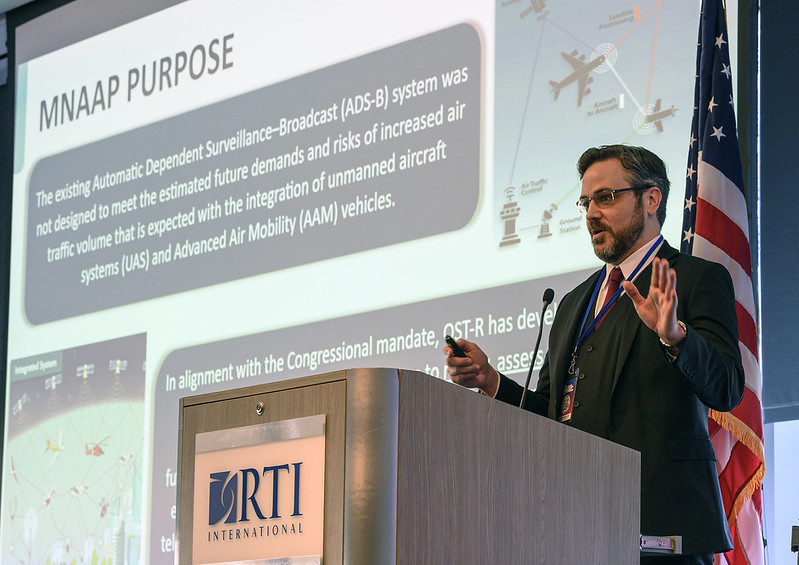
Wireless autonomy doesn’t fail in theory; it fails in complex, messy environments with spectrum congestion, altitude effects, mobility constraints, and unpredictable interference. AERPAW’s value lies in its ability to test autonomy, wireless systems, and UAV operations at scale, under conditions that actually resemble deployment. The AERPAW presentation explained why experimentation needs to reflect real-world challenges and environments for success.
With fixed and mobile nodes, UAVs, rovers, 4G/5G networks, LoRa gateways, and FCC Innovation Zone access, AERPAW enables experimentation that blends autonomy, communications, sensing, and policy realities into a single environment.
This matters because advanced mobility systems are no longer single-technology products. They are stacked systems with hardware, software, connectivity, regulation, and operations intertwined.

(4) Credibility Is Built, Not Claimed
As the Symposium made clear, credibility in advanced mobility isn’t earned through ambition alone. It’s built through evidence, participation, and repeatable results. AERPAW’s work brought this point to life, shifting the conversation beyond infrastructure toward the ecosystem required to make innovation trustworthy and scalable.
Hundreds of real-world experiments, dozens of openly shared datasets, and collaboration with universities around the world aren’t just academic milestones. They are proof points. This kind of shared learning at scale creates the transparency regulators demand, the reliability operators need, and the confidence communities expect.
In an industry where safety and trust are non-negotiable, repeatable experimentation and open data establish credibility faster than vision statements ever could. Workforce development ensures progress doesn’t stall due to talent gaps, while community engagement normalizes cross-sector collaboration and accelerates adoption.
All Symposium presentations and panel discussions demonstrated a broader truth across advanced mobility: organizations that invest early in ecosystems, such as testbeds, standards bodies, research partnerships, and workforce pipelines, are the ones best positioned when commercialization windows open. Credibility is cumulative.

What This Means for Advanced Mobility Leaders
The Symposium exposed that the next phase of advanced mobility will not be won by the loudest demos or the most ambitious roadmaps.
It will be won by teams that:
- Design with operators, not just end users, in mind
- Treat policy as a design constraint, not an afterthought
- Build transition readiness into pilots from day one
- Invest in workforce, supply chains, and communications alongside technology
- Understand that timing and trust matter as much as performance

This is where strategy, storytelling, and execution converge.
At Seez, we work with companies pioneering these efforts, where innovation is real, but scale feels elusive.
Our consulting, marketing, and performance approach is built around helping organizations:
- Translate complex capabilities into compelling, credible narratives for regulators, partners, and customers
- Align go-to-market strategy with policy, funding cycles, and ecosystem dynamics
- Measure what actually matters as systems move from experimentation to deployment
We know that advanced mobility isn’t short on innovation. What it needs is alignment across technology, policy, capital, and communication.
The mobility experts at the AUVSI NC Advanced Mobility Symposium called out the work still required to ensure that progress sticks. And that is a challenge worth solving together. Let’s chat.
All photo credits: Randy Piland